Antoni Gaudí: The Listening Builder
Gaudí treated nature as a co-author. His buildings in Barcelona feel less designed than grown — and his unfinished basilica is still being built by people he never met.
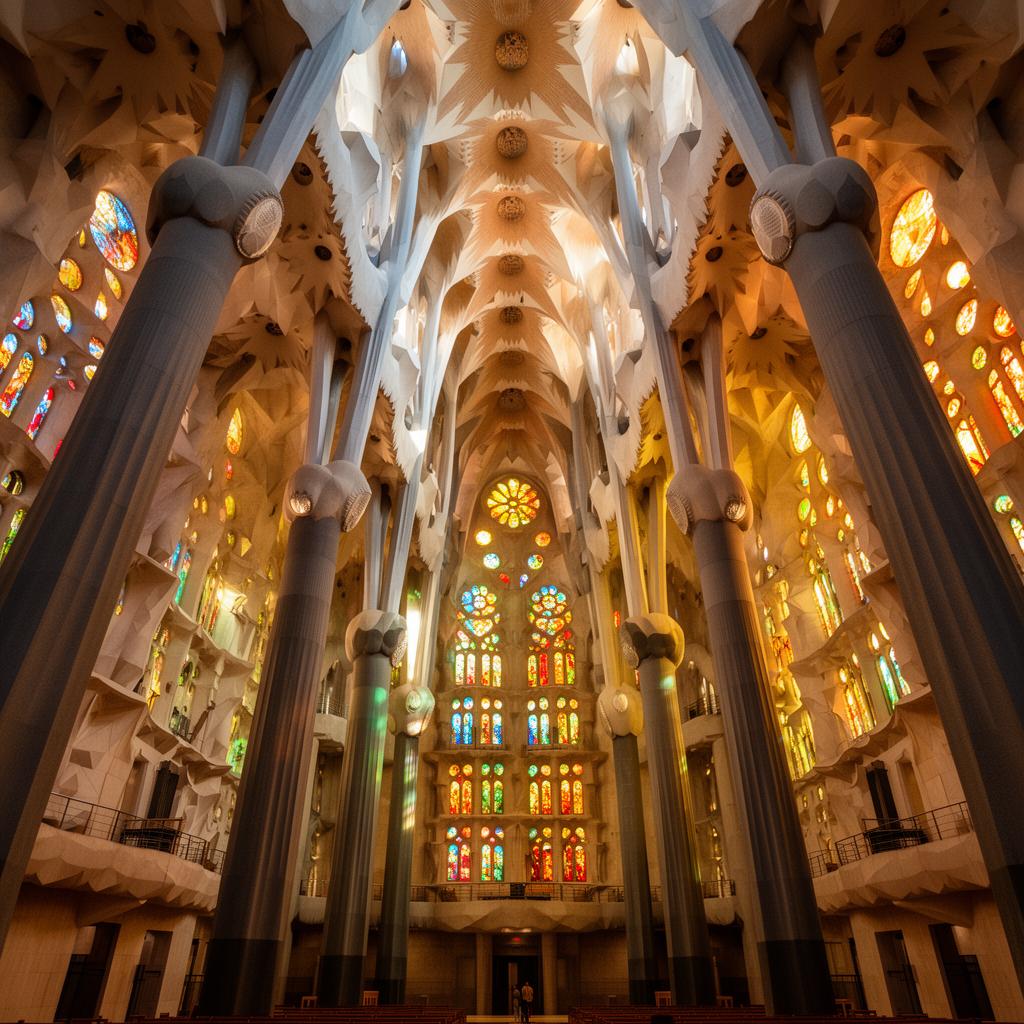
Gaudí was a sickly child. The rheumatism that kept him out of games kept him outside instead, sitting still for hours in the fields around Riudoms, watching things. He said much later that his architecture had started there, in those summers — and he meant it literally, not romantically. The branching of a carob tree was a structural diagram. A snail's shell was a stairwell. He filed the observations away and spent the next sixty years drawing on them.
His early Barcelona commissions are charming and a little awkward — Casa Vicens with its tiled exuberance, the Güell estate gates with their wrought-iron dragon. You can feel him searching. The breakthrough is the moment he stops drawing curves and starts deriving them. He built upside-down models out of weighted chains hanging from a board; gravity pulled the strings into perfect catenary arcs, and when he photographed them and turned the picture over, he had a roof that needed no buttresses. The Sagrada Família was engineered by hanging string and sandbags from a ceiling.
Casa Batlló and Casa Milà followed, then Park Güell, which the city of Barcelona almost demolished as a failed real-estate development before deciding, decades later, that it was a masterpiece. He grew increasingly devout and increasingly ascetic. By the end he was living on the construction site of the Sagrada Família, sleeping in a small room next to the workshop, refusing salary, designing one chapel at a time so the work could continue without him. He was hit by a tram in 1926 and, dressed too shabbily to be recognised as a famous man, lay unidentified in a pauper's ward for a day before someone realised.
The basilica is still being built. The crews working on it now follow the suspended models he left behind and improvise from his fragmentary notes; computational geometry has, somewhat miraculously, caught up with his hand calculations. The man's actual philosophy was simpler than it looks from the buildings: nature had already solved most of these problems, and his job was to copy carefully.
“The best buildings teach you how to be in a room.”
We will leave the last word to the reader. The questions below are not rhetorical. They are an invitation.
Before you comment, consider:
- 01
What does it mean to treat nature as a co-author rather than a backdrop?
- 02
Can a building belong to many generations of builders and still feel like one work?
- 03
Which forms in your own landscape — a tree, a coastline, a stone — could become architecture?
Join the discussion
This is a journal, not a comments section. Share a building you love, a tradition from your region, or a memory a room once gave you. All voices, all cultures, all perspectives are welcome here.
- Anya PetrovTbilisi, Georgia3 days ago
Read this twice. The bit about the doorway feeling like a welcome — my grandmother's house in Sighnaghi has exactly that, a low stone arch you have to dip your head under, and you arrive in the courtyard already softened. I don't think she would have called it architecture. But it is.
- Joaquín RiberaMexico City2 days ago
Writing this from a rooftop in Coyoacán. The neighbour's bougainvillea is doing more for the street than anything the developers put up last year. I think you're right that the older traditions were generous, but I'd push back gently — generosity is also a choice we have to keep making now, and most of the new towers here aren't choosing it.
- Mei TanakaKyotoyesterday
There's a word in carpentry here, kigoroshi, for crushing wood fibres so the joint swells back tight over time. I thought of it reading your paragraph on continuity. The good buildings are the ones that include the future in the calculation.
- Amadou DialloDakaryesterday
If you ever get the chance to be in Djenné for the replastering of the Great Mosque, go. The whole town climbs the walls. Children carry water. Old men direct from the shade. The building is never finished, which is the entire point. Thank you for writing this with care.
From the same shelf

How Architecture Began: From Shelter to Symbol
Long before drawings, before the word architect existed, people were already building. A short history of how shelter became symbol — across every continent.
Imhotep: The First Architect We Know by Name
Physician, advisor, poet, builder. The life of the man behind the Step Pyramid — and what his career tells us about where architecture comes from.